Thursday, 28 February 2013

Golfer’s Elbow (Medial Epicondylitis)


In my last blog, I wrote about the common condition, tennis elbow, or lateral epicondylitis. In this article, I will discuss a similar, but not as common condition, golfer’s elbow, or medial epicondylitis.

What is Golfer’s Elbow?
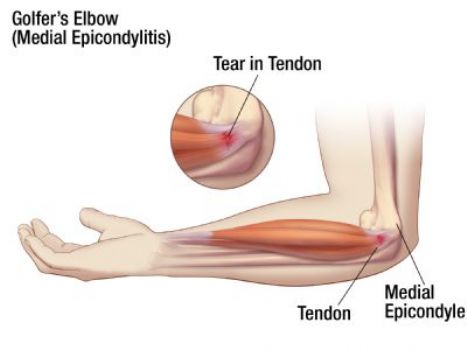
Golfer’s elbow, or medial epicondylitis, is the inflammation of the tendons that run over the medial epicondyle of the elbow joint, more specifically, the tendons of the flexor carpi radialis and pronator teres muscles. This is the inside of the elbow, as opposed to lateral epicondylitis, which affects the outside of the elbow.


Cause
Golfer’s elbow is similar to tennis elbow in that it is also an overuse injury; however, in this case, excessive strain is placed on the medial muscles of the forearm during the acceleration phase of the throwing action.

Symptoms
Swelling, pain and tenderness are usually felt over the inside of the elbow and may continue down the inner forearm muscles. Pain is exacerbated by resisted flexion of the wrist. As with tennis elbow, pain increases with increased activity.

Management and Rehabilitation
The initial pain and swelling can be managed with rest, ice and anti-inflammatory drugs. Physiotherapy is also recommended to help decrease the acute pain and inflammation. Any activities that cause pain, especially overhead and throwing actions should be avoided. Gentle range of motion exercises should be done initially, together with light strengthening exercises, all within a pain-free range. Range of motion and strength of the wrist and shoulder should be maintained as far as possible. A Biokineticist should be consulted, so that progression is appropriate and the technique correct.

(Foundations of Athletic Training)

Thursday, 31 January 2013

Tennis Elbow (Lateral Epicondylitis)

Many of you would have come across the term ‘tennis elbow’ and some of you may have suffered from this condition. Despite its common name, this condition is not only found in tennis players. In fact, it is the most common overuse elbow injury in adults (Foundations of Athletic Training).

What is Tennis Elbow?
The medical term for this condition is lateral epicondylitis, as it refers to inflammation of the tendon, more specifically, the common extensor tendon, that passes over the lateral epicondyle, that is, the outside of the elbow.


Cause
Tennis elbow is an overuse injury caused by repetitive loading of the lateral forearm muscles during the deceleration phase of actions such as throwing or a tennis stroke.

Symptoms
Pain is felt over the outside of the elbow and into the forearm muscles and is usually felt both during and after physical activity involving these muscles. As activity increases, so the pain becomes more severe.

Management and Rehabilitation
The acute pain can be alleviated with rest, ice, compression and anti-inflammatory drugs. One should avoid activities that exacerbate the pain, as well as gripping activities. Stretching exercises within a pain-free range should be performed. A strengthening programme for the shoulders, arms, and wrists will also help to alleviate this condition. This programme should be performed under the guidance and supervision of a Biokineticist, and the progression should be slow and controlled, making allowance for increased activity as and when the pain allows.

Thursday, 13 December 2012

Posture and Falls in the Elderly


In my last blog, I discussed the importance of ankle rehabilitation and continued mobility in maintaining balance, especially in the elderly population. I also briefly mentioned how poor posture in the elderly can often contribute to the high prevalence of falls. Here, I will discuss this in more detail.

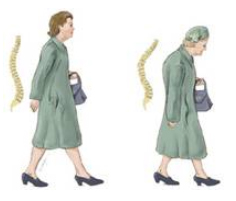
As I mentioned previously, a common trait in the elderly is their shuffled walking pattern and stooped posture, both significant contributing factors to the high incidence of falls in older adults.


Many factors play a role in contributing to the stooped posture seen in the elderly:
·         Reduced eyesight, causing people to look down at their feet to see where they are going
·         Weakened abdominal muscles
·         Weakened upper back and neck muscles
·         Limited arm swing
·         Shuffled walking due to reduced hip flexion, poor balance and limited ankle flexibility and stability – discussed previously

Poor eyesight will not be dealt with here, but it is important to remember that even if you see a step and it is right in front of you, chances are it will be too late for you to correct your step before tripping. Rather keep your head up, and focus your eyes about 3 metres ahead of you on the ground. This way, you simply have to drop your eyes slightly and you have time to step appropriately before tripping over any uneven surface ahead of you.

Abdominal strengthening exercises should be done regularly in order to maintain core strength, as this keeps one’s posture upright. When you walk, pull you navel in towards your spine, keep your hips underneath your shoulders and walk with long strides, striking the ground with the heel first. Pretend you have a piece of string attached to the top of your head that is gently pulling you up as you walk.

It is very important to maintain strength of the upper back and neck muscles because it is weakness in these muscles that causes the head to drop and the typical stoop to develop. This causes one’s centre of gravity to shift forward, contributing to falls. In order to prevent this, one must keep looking straight ahead and keep the chin tucked in by gently pulling the head back. The upper back muscles can be strengthened by squeezing the shoulder blades together and releasing 10 times and then holding the squeeze for 10 counts at a time. This can be done while waiting in a queue or watching TV.

Finally, arm swing must be maintained to keep balance and a good stride length. As soon as one’s upper body stiffens, the rest of the body does as well, resulting in a shuffle.  

So, remember: walk tall, look ahead, keep the shoulders back, swing the arms, lift the knees and feet, and strike the ground with your heel first! J

Merry Christmas and may you all have a happy and healthy 2013! J


Friday, 30 November 2012

Balance in the Elderly


Following on from my last blog, in which I discussed the importance of ankle rehabilitation and stability, here I will discuss how important ankle stability is with regards to balance in elderly people. As we age, we tend to move less and less, resulting in our joints and muscles stiffening up, which in turn results in less movement again. This vicious cycle continues until we are barely able to move which in turn affects our ability to perform activities of daily living.

When you see an elderly person, the first thing you notice is the typical stooped posture and shuffled walking pattern, both of which are major contributing factors to the high prevalence of falls in the elderly. I will discuss posture in the elderly in the next blog.

Limited ankle stability and mobility are also major contributing factors to loss of balance and thus falls in the elderly. Hence, I again stress the importance of rehabilitating the ankle following an injury, so that movement and strength of the joint are regained as soon as possible. The longer it is left, the worse it will become.

A common movement that becomes limited is lifting of the toes to allow for a heel strike. The ankle mobility required for this movement is reduced and the muscle in front of the shin becomes weak. The consequence of this is that the toes drag along the floor, hooking on uneven surfaces and thus causing a person to trip and fall. A good exercise to prevent this: sit in front of the TV and tap your toes, making sure to lift them as high off the ground as possible, while keeping the heels down. A simple and highly effective exercise!

Another exercise that will help maintain the mobility of the ankle joint is to write the letters of the alphabet using the ankle, so that it is moving in every direction. Again, this can be done while sitting in front of the TV, but be sure to concentrate on moving the ankles through their full range of motion!

The calves are another muscle group that need to be kept strong in order to assist with walking. While standing in the kitchen waiting for the kettle to boil, hold onto the counter and rise up onto the toes and then lower. Repeat this at least 10 times, 3 times a day.

The next group of muscles to target are the hip flexors – the muscles allow you to lift your knees up. These need to be strong so that you can lift your leg up off the ground to achieve a heel strike. To strengthen these, simply march on the spot, again holding onto the counter while waiting for the kettle to boil.

Finally, balance is required to walk, thus it is vital to practice balancing on one leg so that the ankles stay accustomed to it. Again, while standing at the kitchen counter, stand on one leg, keeping your hands near the counter to catch you if necessary – safety first, as you do not want to fall!


Remember: when you walk, you need to lift your knees to pick your feet up off the ground, strike the ground with your heel and then push off with your toes. Watch where you walk, and if the surface is uneven, exaggerate the movements so that you don’t trip!

If you are struggling with walking and balance, consult a Biokineticist, as it is essential to keep moving as much as possible as you age!

Tuesday, 30 October 2012

Ankle Stability


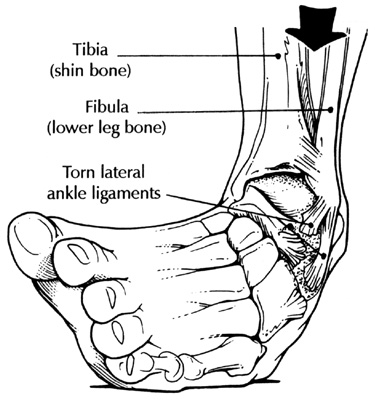
The ankle is a complex joint, comprised of numerous ligaments and supporting structures. Together with the foot, the lower limb is an extremely vulnerable part of the body, as it is responsible for supporting the entire body while changing direction, kicking, as well as all other movements that are performed. Injuries, such as ankle sprains, muscle strains or ligament damage, amongst others, are therefore very common in the lower limb and can be debilitating.

Many people complain about ‘weak ankles’, ‘rolling their ankles’, or ‘going over on their ankles’. This is generally due to poor ankle stability, an aspect of conditioning that is often neglected. The result can be a ligament sprain or muscle strain, which can be very painful and which can take a very long time to heal.


In order to prevent an ankle sprain or to adequately recover from such an injury, one must do ankle stability exercises to strengthen the supporting muscles and ligaments around this joint. Such exercise include simple actions like balancing on one leg to more complex actions like standing on one leg on an unstable surface while performing some kind of movement with the rest of the body. The progression of these exercises depends on how unstable the ankle joint is. It is important, therefore, that this progression is carefully monitored by a Biokineticist, especially after an injury, so that re-injury doesn’t occur.


So, it is important to remember to look after your ankles. Think back to previous ankle problems that almost all of us have had at some point, and think how this has hindered your daily activities. Take the time to do a few simple exercises to ensure that the integrity of this joint is restored and maintained. However, if you do run into this common problem, consult a Biokineticist before resuming any form of active participation.